The Question
What exact physical process occurs when sunlight strikes a falling raindrop to create a vibrant, multi-colored arc in the sky? Rainbows have inspired mythology and art for millennia, but the scientific explanation is an elegant demonstration of optics, involving the bending, bouncing, and splitting of light.
Detailed Explanation
A rainbow is not a physical object in a specific location in the sky; rather, it is an optical phenomenon that depends on your position relative to the sun and the rain. To see a rainbow, you must have the sun behind you and water droplets in front of you. The formation involves three distinct steps: refraction, reflection, and dispersion. First, as a ray of sunlight enters a spherical raindrop, it slows down and bends—this is called refraction. Because the drop is denser than the air, the light is forced to change direction. Inside the drop, the light hits the back surface and bounces off—this is internal reflection. Finally, as the light exits the drop, it refracts again, speeding up as it returns to the air. The 'magic' of the colors happens because white sunlight is actually a mixture of all visible colors. Each color travels as a wave of a different length. When light enters and exits the water, these different wavelengths bend at slightly different angles. Shorter wavelengths (like violet and blue) bend more sharply, while longer wavelengths (like red) bend less. This separation of light into its component colors is called dispersion. By the time the light has bounced and bent through millions of raindrops, the colors have spread out enough for the human eye to see them as distinct bands. Red always appears on the outer edge of the arc because it exits the drops at a steeper angle (about 42 degrees), while violet appears on the inner edge because it exits at a shallower angle (about 40 degrees).
Going Deeper
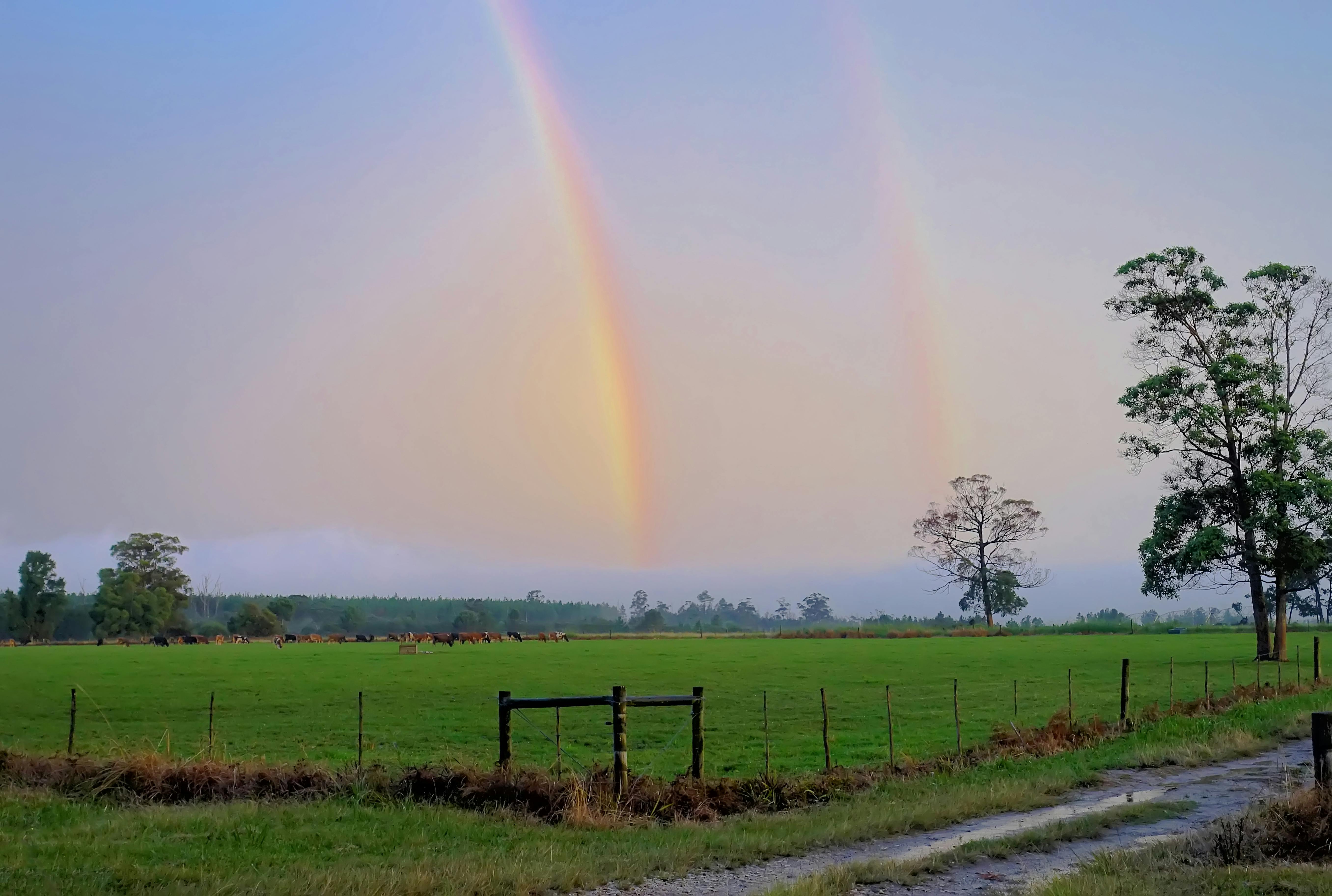
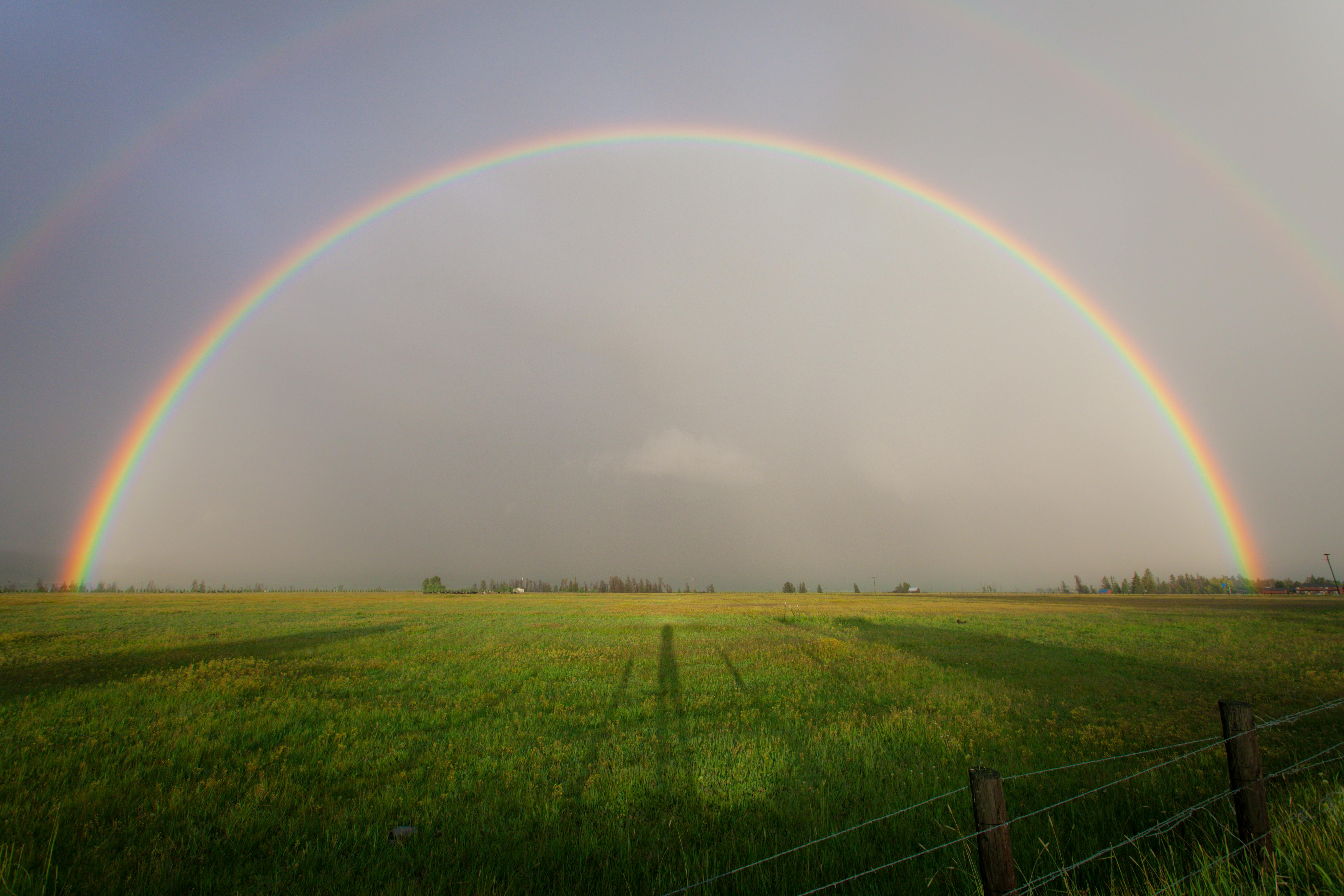
The circular shape of a rainbow is a result of the geometry of the light exiting the raindrops. Each raindrop reflects and refracts light in a cone shape. You only see the light from the drops that are at a specific angle (between 40 and 42 degrees) relative to the line between your head and your shadow. All these drops form a circle around that central point (the 'anti-solar point'). From the ground, the horizon usually cuts off the bottom half of this circle, which is why we see a semi-circular arc. However, if you are in an airplane or on a high mountain, you can sometimes see a full-circle rainbow. Sometimes, you might see a 'secondary rainbow' above the main one. This occurs when the light reflects twice inside the raindrop instead of once. Because of the extra reflection, the colors in the secondary rainbow are reversed—red is on the inside and violet is on the outside—and the arc is much fainter because some light is lost with each reflection. Another interesting detail is that no two people see exactly the same rainbow. Because the rainbow depends on the specific angle of light entering your eyes, even if someone is standing right next to you, they are receiving light from a slightly different set of raindrops. Each person is effectively at the center of their own unique personal rainbow.
Did You Know?
You can create your own rainbow on a sunny day with a garden hose. By standing with your back to the sun and spraying a fine mist of water, you can see the same principles of refraction and reflection in action on a small scale. Another fascinating example is the 'moonbow,' or lunar rainbow. These are formed in the same way as daytime rainbows but are caused by moonlight instead of sunlight. Because moonlight is much fainter, moonbows often appear white to the human eye because our color receptors aren't sensitive enough in low light, though long-exposure photography reveals they contain the same full spectrum of colors. There are also 'fogbows,' which form in much smaller droplets of fog. Because the droplets are so tiny, the light waves interfere with each other through a process called diffraction, which smears the colors together, resulting in a beautiful, ghostly white arc.